In two dimensions, all brick unions can be described with one integer quantity
-- the number of knobs that join two bricks. Table 2.1
gives all the information needed to describe 2D brick joints. In the three dimensional
case, brick unions are n-by-m rectangles. Two  bricks for example can be stuck together in 8 different types of joints:
 ,
,
 ,
,
 ,
,
 ,
,
 ,
,
 ,
.
,
.
We know already, from the 2D case, how  unions respond to forces
acting along the x axis alone. A
union supports more
than double the torque admitted by a ,
the reason being that
the brick itself acts as a fulcrum (fig. 2.1). The distance from
the border to the first knob is shorter than the distance to the second knob,
resulting in a lower multiplication of the force for the second knob. This fulcrum
effect does not happen when the force is orthogonal to the line of knobs. A
union can be considered as two
unions, or
as one joint with double the strength of a
(fig. 2.3).
unions respond to forces
acting along the x axis alone. A
union supports more
than double the torque admitted by a ,
the reason being that
the brick itself acts as a fulcrum (fig. 2.1). The distance from
the border to the first knob is shorter than the distance to the second knob,
resulting in a lower multiplication of the force for the second knob. This fulcrum
effect does not happen when the force is orthogonal to the line of knobs. A
union can be considered as two
unions, or
as one joint with double the strength of a
(fig. 2.3).
In other words, when torque is applied along a sequence of stuck knobs, the
fulcrum effect will expand the resistance of the joint beyond linearity (as
in table 2.1). But when the torque arm is perpendicular
instead, knob actions are independent and expansion is just linear.
|
|
We thus state the following dimensional independence assumption: Two
bricks united by  overlapping knobs will form a jointwith a capacity Kx along the x axis equal
to m times the capacity of one n-joint and Ky
along the y axis equal to n times the capacity of an m-joint.
overlapping knobs will form a jointwith a capacity Kx along the x axis equal
to m times the capacity of one n-joint and Ky
along the y axis equal to n times the capacity of an m-joint.
To test the resistance of a composite joint to any spatial force f we
separate it into its two components, fx on the xz plane
and fy on the yz plane. These components induce two
torques  ,
,  .
To break the joint either
must be larger than Kx or larger than Ky.
.
To break the joint either
must be larger than Kx or larger than Ky.
If the dimensional independence hypothesis was not true, a force exerted along one axis could weaken or strengthen the resistance in the orthogonal dimension, but our measurements suggest that the presence of stress along one axis does not modify the resistance along the other. It is probably the case that the rectangular shape of the joint actually makes it stronger for diagonal forces, implying that dimensional independence is a conservative assumption. In any case, separating the components of the force has been a sufficient approximation for the scope of our experiments.
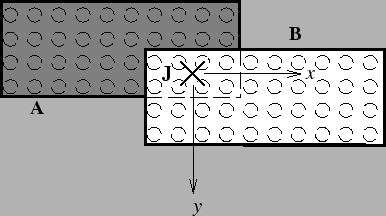
 joint J. Along x
the joint is a double
joint J. Along x
the joint is a double  joint. Along the y axis it is
a quadruple
joint. Along the y axis it is
a quadruple